Introduction
Central kitchens have become the backbone of modern food service operations, supporting restaurant chains, hotels, catering companies, and ready meal manufacturers. By centralizing production, businesses can improve consistency, reduce labor costs, and streamline food distribution across multiple locations.
However, as production scales up, one challenge becomes increasingly critical: maintaining a stable cold chain system. In many central kitchen projects, refrigeration infrastructure is often underestimated until operational issues begin to appear. Common problems include insufficient storage capacity, cross-contamination risks between raw and cooked foods, inconsistent product quality caused by temperature fluctuations, and cold rooms that fail to integrate with production workflows.
A cold room in a central kitchen is far more than a storage space. It functions as an essential part of the production process, influencing food safety, operational efficiency, and product consistency. This article explores the key principles of central kitchen cold room design, including layout planning, temperature zoning, refrigeration system selection, and cold chain integration.
Why Central Kitchen Cold Rooms Are Critical in Food Production Systems
Cold Room as a Core Part of Production Flow
In traditional facilities, cold rooms were often viewed as standalone storage areas. Modern central kitchens operate differently.
A properly designed cold room serves multiple production functions:
- Raw material buffer storage
- Semi-finished product holding area
- Finished product dispatch center
- Temperature control point within the production cycle
Because materials continuously move through different processing stages, cold room performance directly impacts workflow efficiency and production stability.
Why Demand Is Increasing in Centralized Food Production
The growth of central kitchen facilities is being driven by several industry trends:
- Expansion of restaurant chains
- Standardization of food quality
- Centralized procurement systems
- Growth of ready-to-eat and ready meal industries
- Increasing labor costs
As production volume increases, refrigeration systems become one of the most critical infrastructure investments. In many facilities, bottlenecks occur not because of insufficient production equipment, but because the cold chain cannot support the required product flow.
Food Safety Pressure in Central Kitchen Operations
Food safety risks in central kitchens often arise during processing rather than at the final delivery stage.
Common risk factors include:
- Mixing raw and cooked foods
- Improper temperature control
- Cross-contamination between work areas
- Inadequate product segregation
Under HACCP-based food safety programs, cold rooms are considered critical control points (CCPs) that help prevent microbial growth and maintain product integrity throughout production.
Central Kitchen Cold Room Design Logic
Layout Design Must Follow Food Flow, Not Room Shape
One of the most common mistakes in cold room design is prioritizing available building space rather than operational workflow.
Effective cold room design should follow the movement of food products through the facility:
Raw Materials → Pre-processing → Chilled Storage → Cooking → Blast Cooling → Finished Goods Storage → Distribution
Cold rooms should be positioned according to this process flow to minimize unnecessary movement and reduce handling time.
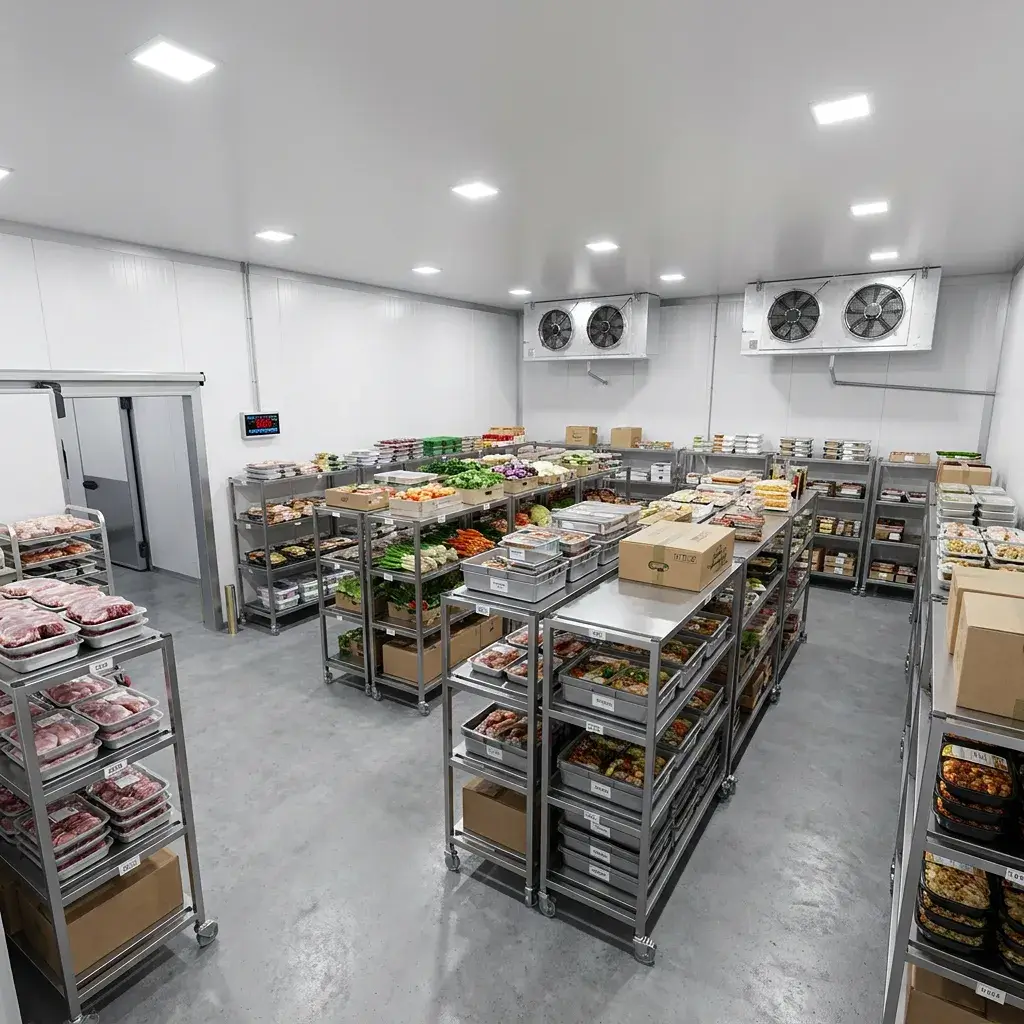
Separation of Raw, Cooked, and Semi-Finished Zones
Food segregation is a fundamental requirement in central kitchen operations.
Most facilities should include at least three dedicated storage zones:
Raw Material Storage Area
Used for:
- Meat
- Poultry
- Seafood
- Fresh vegetables
Semi-Finished Product Storage Area
Used for:
- Prepared ingredients
- Marinated products
- Intermediate processing stages
Finished Product Storage Area
Used for:
- Ready meals
- Cooked foods
- Packaged products awaiting shipment
The objective is not simply organization but preventing contamination pathways and maintaining food safety.
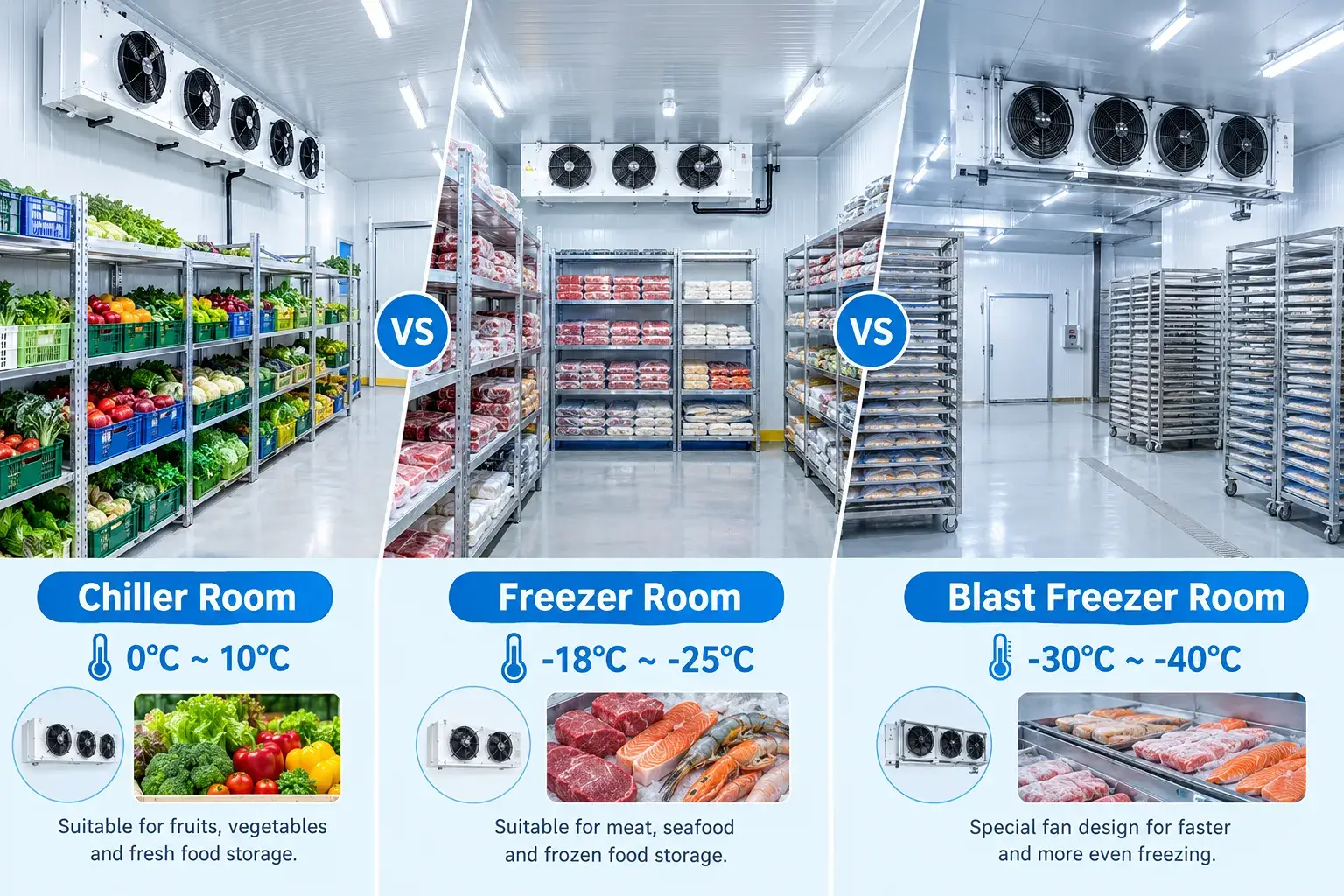
Temperature Zoning Is a Flow Control Tool, Not a Storage Feature
Temperature zones should be designed around operational requirements rather than storage preferences.
The key factor is controlling how long products remain within each temperature zone rather than simply achieving a target temperature.
Energy and Structure Design Must Match Operational Load
Many cold rooms perform well during commissioning but struggle under full production loads.
Common causes include:
- Insufficient insulation
- Frequent door openings
- Undersized refrigeration systems
- Poor airflow design
A successful central kitchen cold room must be designed around actual operating conditions rather than theoretical calculations.
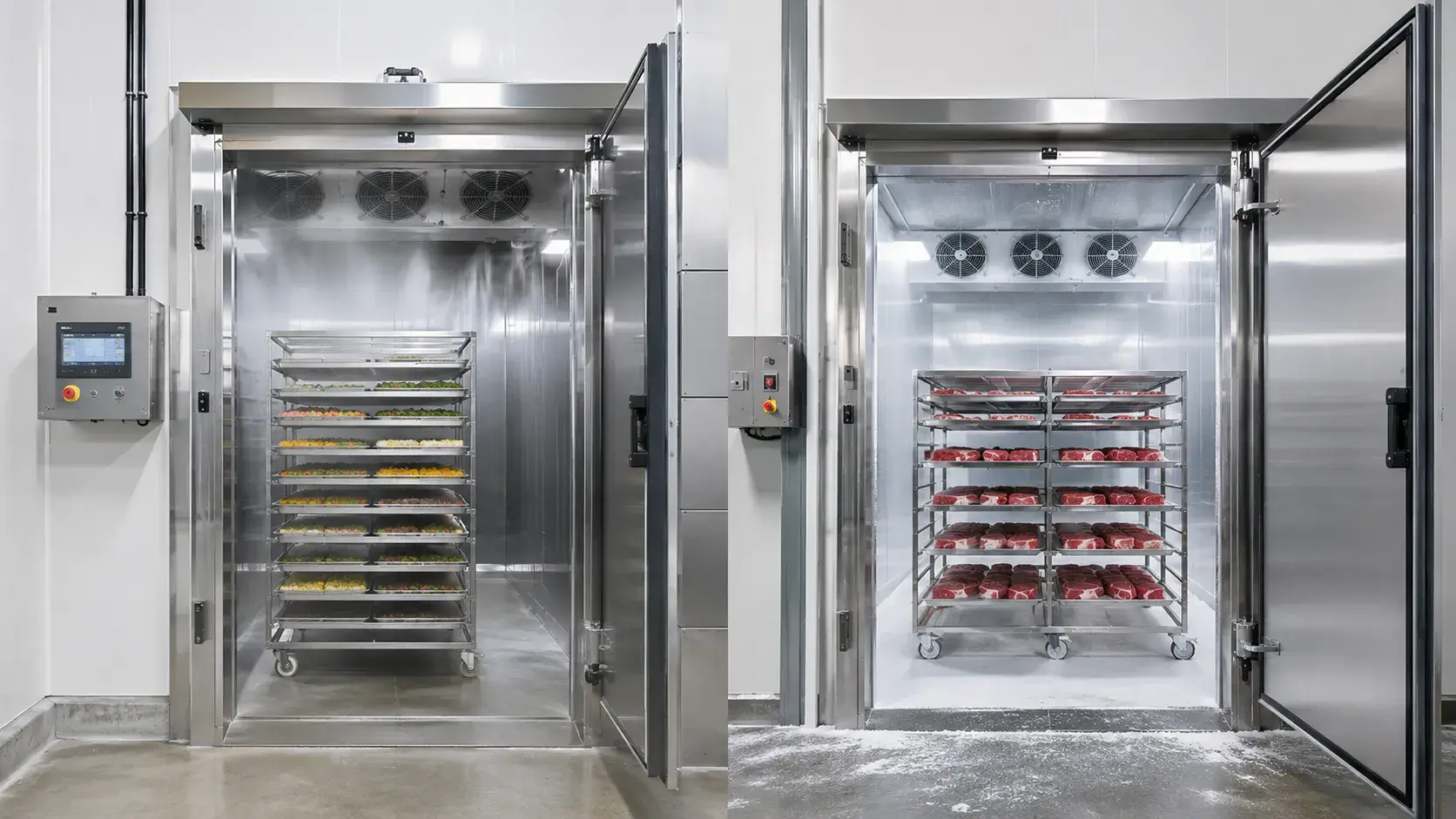
Blast Freezer Integration in Central Kitchen Systems
Role of Blast Freezing in Real Production
A blast freezer is not simply an upgraded freezer. It is an essential production process.
Blast chilling and blast freezing help:
- Rapidly reduce product temperature
- Pass through bacterial growth danger zones quickly
- Preserve texture and moisture
- Improve batch consistency
For ready meals, cooked foods, and prepared ingredients, blast freezing plays a critical role in quality preservation.
Why Skipping Blast Freezing Creates Hidden Risk
Many small facilities place hot products directly into cold storage after cooking.
This approach creates several problems:
- Surface temperature drops faster than core temperature
- Products remain in microbial growth zones longer
- Uneven cooling affects product quality
- Shelf life may be reduced
Blast chilling solves these issues by rapidly removing heat before products enter storage.
Integration With Cold Room Workflow
A recommended process flow is:
Cooking → Blast Chilling → Buffer Zone → Cold Storage → Distribution
The cold room should function as a stabilization stage after rapid cooling rather than as the primary cooling mechanism.
Cold Chain Architecture in Central Kitchen Facilities
End-to-End Temperature Flow Design
A complete cold chain should cover every stage of production:
- Raw material receiving
- Chilled storage
- Processing preparation
- Cooking
- Blast chilling
- Frozen or chilled finished goods storage
- Cold chain distribution
Any interruption can compromise food quality and increase waste.
Temperature Monitoring Is a Control Tool, Not a Compliance Tool
Many operators view temperature monitoring simply as a regulatory requirement.
In reality, monitoring systems provide valuable operational insights:
- Identifying equipment performance issues
- Detecting abnormal temperature trends
- Supporting product traceability
- Optimizing refrigeration efficiency
Modern systems often use IoT-based monitoring and real-time alarm functions.
Hygiene Design Depends on Physical Isolation, Not Cleaning Frequency
Cleaning is important, but physical separation remains the most effective contamination control strategy.
Best practices include:
- Separate personnel and product flow routes
- Dedicated raw and cooked food zones
- Controlled airflow direction
- Independent storage areas for different product categories
These measures significantly reduce contamination risks.
Benefits of a Well-Designed Central Kitchen Cold Room System
Production Stability
Stable temperature conditions reduce batch variation and support consistent production schedules.
Food Safety Control
Effective zoning and temperature management help prevent bacterial growth and cross-contamination.
Operational Efficiency
Optimized layouts reduce handling time and improve material movement throughout the facility.
Waste Reduction
Stable storage conditions minimize spoilage, shrinkage, and product rejection caused by temperature fluctuations.
Common Design and Operation Issues
Layout Not Aligned With Production Flow
Poor positioning of cold rooms often creates unnecessary transportation and labor costs.
Undersized or Oversized Cooling Capacity
Undersized systems may struggle to maintain temperature, while oversized systems increase operating costs and energy consumption.
Missing Blast Cooling Stage
Skipping blast chilling often results in lower product quality, reduced shelf life, and increased food safety risks.
Weak Separation Between Zones
Mixing raw and cooked products remains one of the most common design mistakes in food production facilities.
How to Choose a Central Kitchen Cold Room System
Modular vs Built-In Systems
Modular Cold Rooms
Best suited for:
- Expanding production facilities
- Flexible operations
- Future capacity growth
Built-In Cold Rooms
Best suited for:
- Stable production volumes
- Large-scale facilities
- Permanent installations
Capacity Planning Based on Production Cycle
Cold room sizing should be based on:
- Daily processing volume
- Inventory turnover rate
- Peak production periods
- Future expansion plans
Designing solely based on available floor space often leads to inefficiencies.
Energy and Lifecycle Cost Consideration
The true cost of a cold room extends beyond equipment purchase.
Important factors include:
- Energy consumption
- Maintenance requirements
- Equipment lifespan
- Operational reliability
Lifecycle cost analysis often reveals that higher-quality systems provide lower long-term operating expenses.
People Also Ask
What is the function of a cold room in a central kitchen?
A cold room stores raw materials, semi-finished products, and finished foods while maintaining safe temperatures and supporting production workflow.
How should a cold room be designed for food production facilities?
The design should follow food processing flow, include temperature zoning, separate raw and cooked products, and integrate with production operations.
Why is blast chilling important in central kitchens?
Blast chilling rapidly reduces food temperature, minimizes bacterial growth, improves product consistency, and extends shelf life.
How do you prevent cross-contamination in cold storage?
By implementing physical separation between raw and cooked products, controlling airflow, and maintaining dedicated storage zones.
Where should a cold room be placed in a commercial kitchen layout?
A cold room should be positioned according to material flow, allowing efficient movement between receiving, processing, cooking, cooling, storage, and distribution areas.
Conclusion: Designing a Stable Central Kitchen Cold Chain System
The success of a central kitchen refrigeration system depends less on equipment specifications and more on how effectively the cold room is integrated into the production process.
The most efficient central kitchen cold room systems share three common characteristics:
- Stable and consistent temperature control
- Smooth product flow throughout production
- Clear separation of storage zones and food categories
As food production facilities continue to expand, refrigeration systems are evolving from simple storage infrastructure into critical operational assets.
Future Direction
The next generation of central kitchen cold chain systems is moving toward:
- Integrated production and cold storage design
- Smart temperature monitoring and automated logistics
- Modular cold room solutions for scalable expansion
For restaurant chains, ready meal manufacturers, and commercial food processing facilities, investing in a properly designed central kitchen cold room is essential for achieving food safety, operational efficiency, and long-term business growth.