Introduction
The prepared meal industry has grown rapidly in recent years, driven by the expansion of central kitchens, food delivery platforms, frozen food e-commerce, and ready-to-eat retail products. As production scales up and distribution networks become more complex, maintaining product quality throughout the supply chain has become increasingly challenging.
Unlike many shelf-stable foods, prepared meals are typically cooked products with high moisture content and relatively short shelf lives. Their texture, flavor, and safety can be significantly affected by temperature fluctuations during storage and transportation.
One common misconception is that cold chain performance is only about maintaining low temperatures. In reality, even small disruptions at one stage of the process can create quality issues that become amplified throughout the entire distribution cycle.
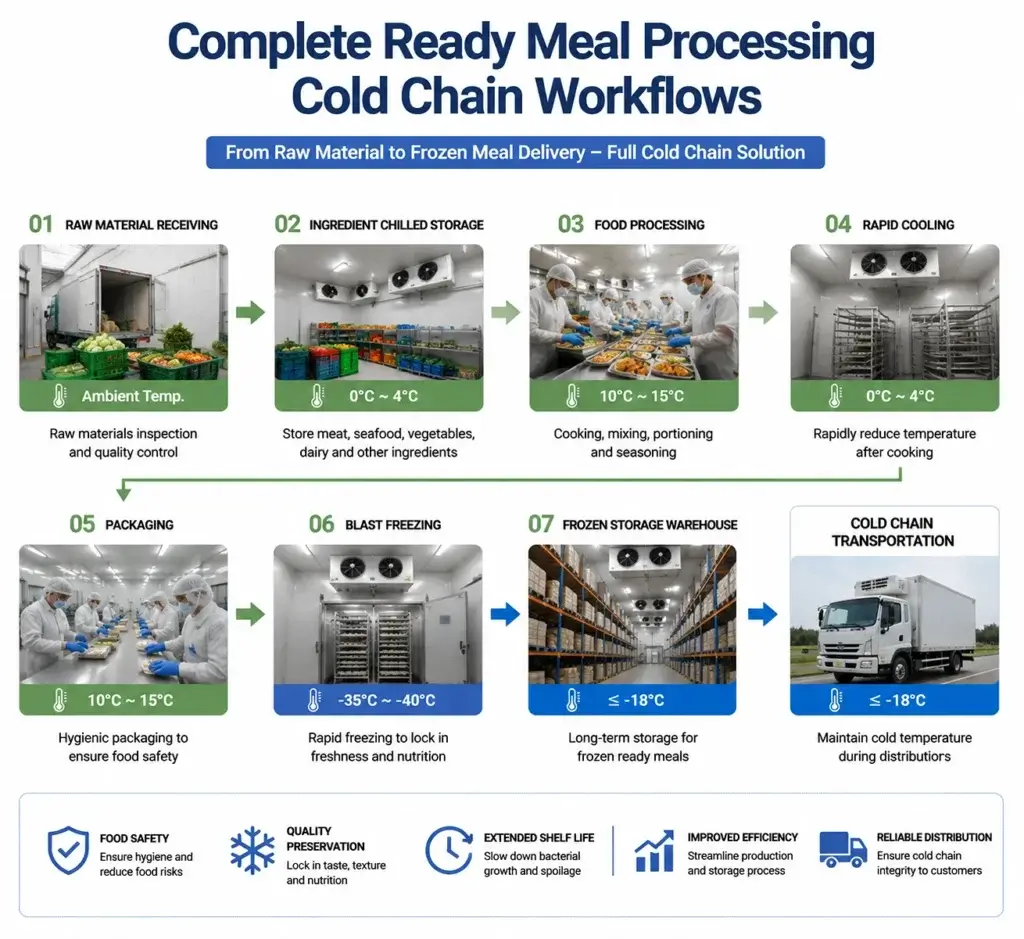
A reliable prepared meal cold chain must ensure continuous temperature stability from production to consumption, including:
- Rapid cooling after processing
- Stable cold room storage
- Temperature-controlled transportation
- Last-mile delivery management
If any link in the chain fails, product quality and shelf life may be difficult to recover.
Why Prepared Meal Cold Chain Fails in Practice
Market Growth Behind the Demand
The growing demand for prepared meals is closely linked to several industry trends:
- Expansion of centralized food production facilities
- Rising consumer demand for convenient ready-to-eat meals
- Growth of frozen food e-commerce and regional distribution networks
- Increasing standardization in restaurant and food service operations
As businesses scale production, many discover that manufacturing capacity is rarely the primary challenge. The real bottleneck is often maintaining consistent product quality across increasingly complex distribution networks.
Ultimately, that consistency depends on the stability of the cold chain.
What Actually Breaks the Cold Chain
In real-world operations, cold chain failures rarely occur as dramatic system breakdowns. More often, quality degradation results from repeated minor temperature deviations.
Common issues include:
- Partial thawing followed by refreezing
- Accelerated microbial activity due to temperature fluctuations
- Reduced shelf life
- Inconsistent quality between production batches
- Customer complaints regarding texture and taste
These problems are difficult to replicate under laboratory conditions but frequently emerge during actual transportation, storage, and distribution.
Key Factors in Temperature-Controlled Storage
Storage Temperature Is Not the Real Issue
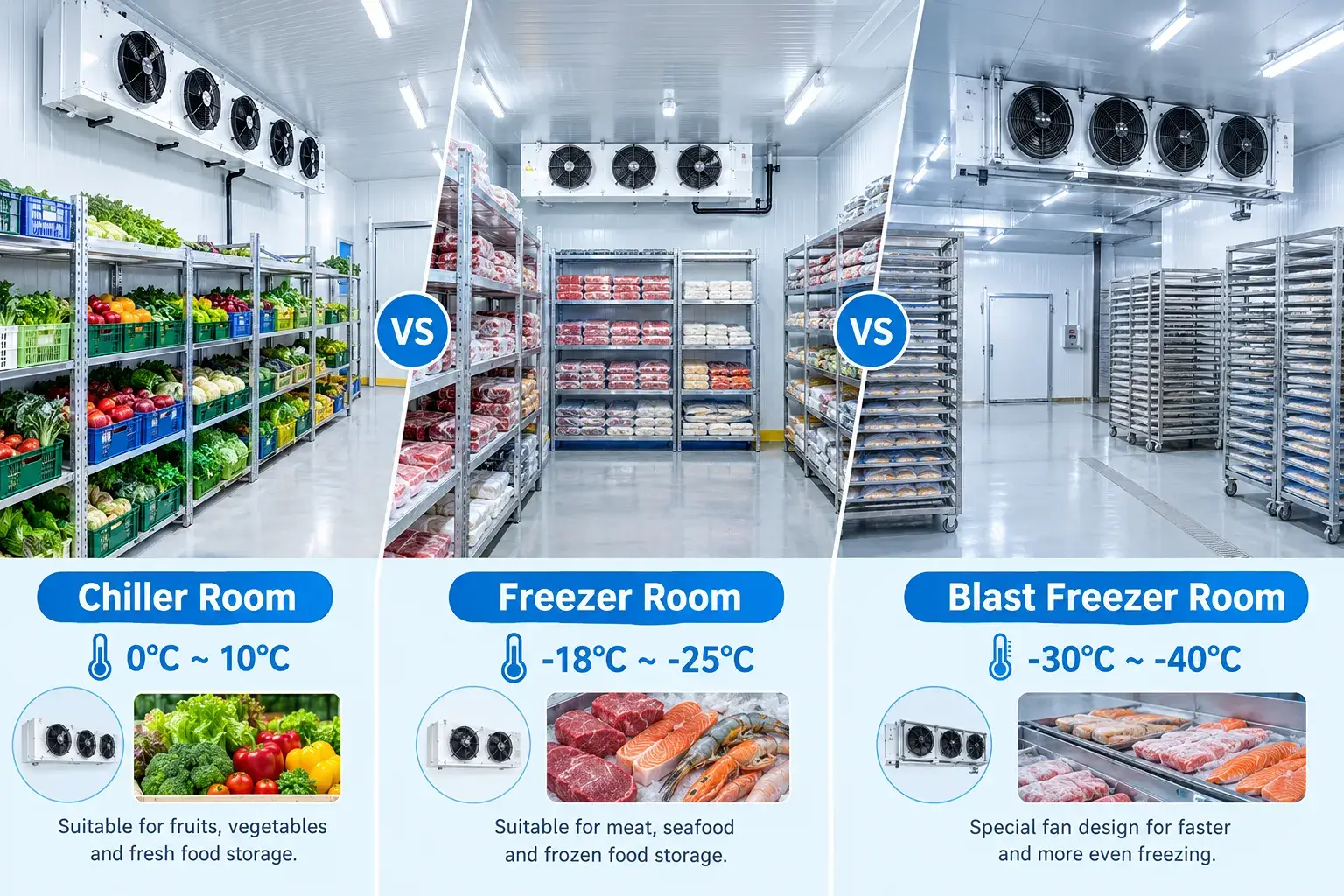
Prepared meal storage generally falls into two categories:
| Storage Type | Temperature Range |
| Chilled Storage | 0°C to 4°C |
| Frozen Storage | -18°C or below |
While these temperature ranges are important, operational performance matters even more.
The key questions are:
- Can the system quickly recover after doors are opened?
- Can stable temperatures be maintained under full load?
- Does performance remain consistent during peak operating periods?
Many cold storage systems perform well during testing but struggle under real operating conditions.
Stability Matters More Than Setpoint
In practice, the biggest challenge is often not achieving the target temperature but maintaining it consistently.
Common causes of instability include:
- Frequent door openings
- Changing product loads
- Poor airflow distribution
- Inadequate refrigeration recovery capacity
For prepared meals, these fluctuations directly impact texture, appearance, and shelf life.
Pre-Cooling Before Storage Is Often Missed
One of the most overlooked stages in prepared meal production is pre-cooling.
When hot or warm products enter storage before sufficient cooling:
- Refrigeration systems experience excessive load
- Internal product temperatures remain elevated
- Cooling becomes uneven
- Microbial activity may continue during temperature transition periods
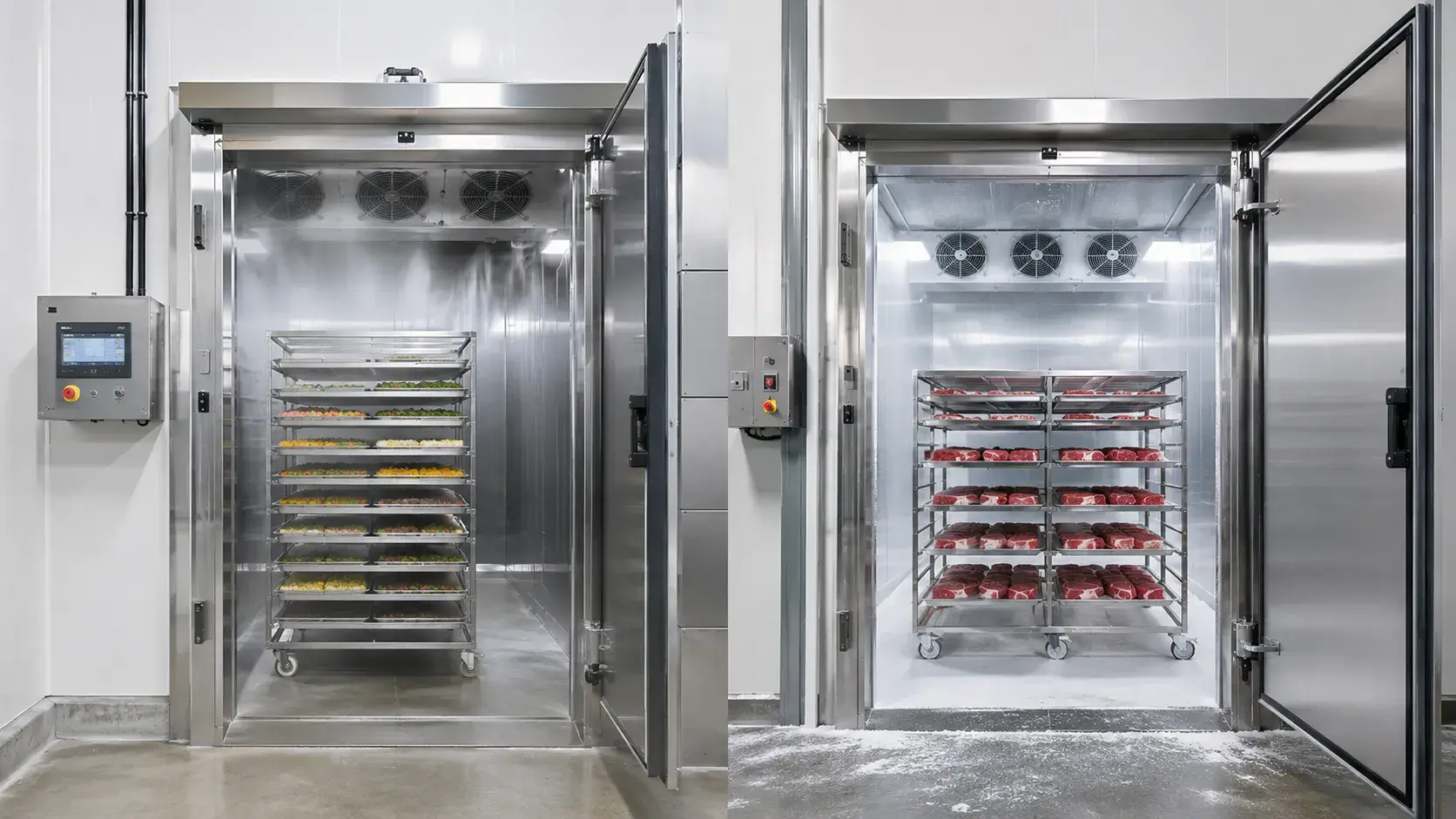
Blast chilling systems are commonly used to rapidly remove heat before products enter cold storage. However, many small and medium-sized facilities underestimate the importance of this step.
Cold Room Design for Frozen Meal Storage
Role of Frozen Storage in the System
Frozen storage facilities serve a much broader purpose than simply storing products.
They often function as:
- Centralized storage hubs
- Production buffers for central kitchens
- Distribution centers for e-commerce fulfillment
- Inventory management hubs for regional supply chains
In many operations, the cold room acts as a critical link between production and logistics.
What Actually Determines Performance
Frozen storage temperatures typically range from -18°C to -25°C.
However, actual performance depends on factors such as:
- Temperature recovery speed after door openings
- Stability under full-capacity operation
- Uniformity across storage zones
- Air circulation efficiency
A system that performs well when empty may behave very differently when fully loaded.
Airflow Is the Real Limitation
Many cold room issues are related to airflow rather than refrigeration capacity.
Typical problems include:
- Direct airflow causing localized frost formation
- Blocked return-air pathways
- Poor circulation in storage corners
- Uneven temperature distribution
Over time, these issues can lead to:
- Temperature stratification
- Excessive frost buildup
- Product quality inconsistencies
Proper airflow engineering is often more important than simply increasing refrigeration capacity.
Hygiene and Layout Matter Early
Prepared meal facilities must also prioritize food safety and sanitation.
Effective cold room design should include:
- Separate storage zones for different products
- Easy-to-clean surfaces and layouts
- Clear batch segregation systems
- Traceability-friendly storage arrangements
Many operational problems originate from poor zoning decisions made during the initial design phase.
Logistics and Packaging Reality
Where Cold Chain Usually Fails
The most vulnerable points in a prepared meal cold chain are often found during logistics operations.
Common risk areas include:
- Loading and unloading activities
- Transportation temperature fluctuations
- Last-mile delivery exposure
Among these, last-mile delivery is typically the most difficult to control due to frequent door openings, traffic conditions, and variable handling practices.
Transportation Strategy in Practice
Prepared meal distribution generally follows two approaches:
Chilled Distribution
- Short delivery cycles
- High delivery frequency
- Fast inventory turnover
Frozen Distribution
- Larger shipment volumes
- Longer storage periods
- Lower delivery frequency
Successful operations often implement:
- Temperature data logging
- Route optimization
- Minimized loading exposure times
The primary objective is to reduce interruptions in temperature continuity.
Packaging as Part of the Cold Chain
Packaging should not be viewed solely as product protection.
It also plays a critical role in temperature management by:
- Slowing temperature rise
- Reducing moisture migration
- Limiting oxidation
- Preventing odor contamination
Especially during final delivery stages, packaging performance can significantly influence product quality.
How Cold Chain Reduces Waste
Reducing waste is not simply a result of having cold storage facilities. It depends on maintaining consistent operating conditions throughout the entire supply chain.
Well-managed cold chain systems typically achieve:
- Lower temperature variability
- Improved batch consistency
- Reduced transportation losses
- Extended shelf life
- Fewer customer complaints
In many projects, improvements become visible quickly once system stability is achieved.
Smart Monitoring in Real Projects
Digital monitoring technologies are becoming standard across modern food cold chains.
Common solutions include:
- IoT temperature monitoring
- Real-time alarm systems
- Batch-level data recording
- Remote equipment monitoring
The value of these technologies lies not only in collecting data but also in enabling rapid problem identification and traceability when issues occur.
Conclusion: What Really Builds a Stable Cold Chain
A successful prepared meal cold chain is not defined by having the lowest temperature or the most powerful refrigeration equipment.
Long-term performance depends on how effectively every component of the system works together.
The three most important factors are:
Temperature Stability, Not Lowest Temperature
Consistent temperature control is far more valuable than excessively low setpoints.
Airflow Management, Not Refrigeration Capacity Alone
Proper airflow distribution ensures uniform cooling and stable product quality.
Logistics Control, Not Warehouse Size
Transportation, handling procedures, and delivery operations often have a greater impact on product quality than storage capacity itself.
Many cold chain failures are not caused by inadequate equipment but by poor integration between processing, storage, transportation, and distribution.
Our Experience in Food Cold Chain Projects
We have delivered cold room and cold chain solutions for various food processing applications, including plant-based foods, prepared meals, and frozen food distribution projects.
Our design focus typically includes:
- Chilled and frozen storage zoning
- Integration of blast chilling and storage systems
- Airflow optimization for high-moisture products
- Inventory buffer design based on shipment schedules
- Temperature stability and loss reduction strategies
These solutions are widely applicable to central kitchens, prepared meal factories, frozen food warehouses, and food distribution centers.
Get a Cold Chain Solution for Your Project
Whether you are planning a prepared meal production facility, central kitchen, frozen food warehouse, or distribution center, selecting the right cold chain system is critical for maintaining product quality and operational efficiency.
Our engineering team can help you evaluate:
- Production capacity requirements
- Product storage temperatures
- Inventory turnover patterns
- Logistics and distribution workflows
- Cold room and refrigeration system configurations
Contact us with your project details, and we can recommend a tailored cold chain solution designed for real operating conditions and long-term reliability.